
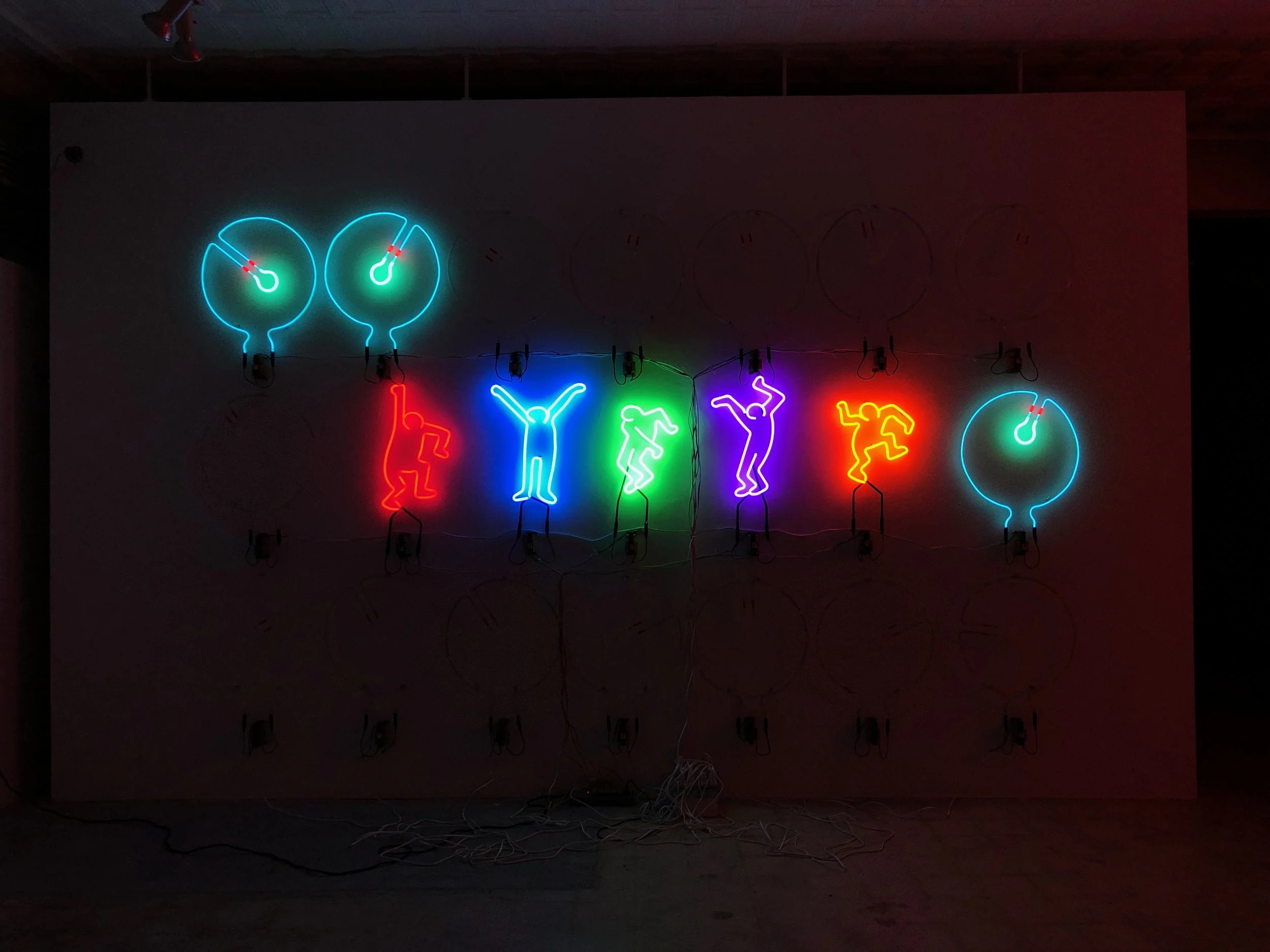
Haring Love, part I: evolution of the Keyhole Torus in tribute to Keith Haring
Haring Love, part I: evolution of the Keyhole Torus in tribute to Keith Haring
Nate Sheaffer
September 6-28,2019

Nate Sheaffer
September 6-28,2019
Nate Sheaffer began studying art under Robert Howard at the University of North Carolina, Chapel Hill in 1984. Large Assemblies of found steel objects, welded and bolted together begged for lightening in some fashion. Bob Howard said one day, “You oughta go see Jerry Noe, put some neon on those things.” The start was just that simple.
The next semester, Independent study with Jerry Noe in the same department led to a lifelong friendship with John Wilhelm, then owner of Paradise Neon, located on Hillsborough Street in Raleigh. Just when Nate was about to graduate and had hopes of going to work for John at Paradise Neon, John was bought up by Illumelex Corporation.
“Start up your own shop,” John said. “You’re not gonna’ like commuting to the other side of Raleigh from Chapel Hill for minimum wage as an apprentice.”
And so, three months after graduating UNC-CH with a degree in German, Nate rented a space behind Mariakakis Greek Restaurant in Chapel Hill, and founded Neon Impressions, Inc. Early work focused on abstractions until the reality of making rent and a living turned Nate down the road of commercial, then later, production neon tubing manufacture.
Along with his brother and partner, Curtis, Nate grew the company quickly, adding a third brother, Garth, as the first employee, followed by dozens more glass blowing apprentices, assemblers, and eventually, an engineer. Into the early and mid nineties, production, wholesale neon tubing and sign manufacturing thrived. The company moved twice – first into a 10,000 square foot hatchery in Pittsboro, NC and then into the former Bells School on Jordan Lake.
A strong alliance with American Neon Signs, of Muenster, Germany, provided a prolific avenue for production and sales driven by ANS founder, Christopher Sheldon.
In 1998, Neon Impressions, Inc. began working as a job shop for large production houses creating tens of thousands of units annually for the alcohol and tobacco industries. In early 1999, the sign industry and production neon signage became one of the many industries to fall prey to offshore competition. It was for the best, for Nate, as production neon signs and wholesale tubing had caused him to stray far from creative work.
For the next seven years, Nate worked as a project manager and estimator for Van Thomas Contractor, Inc. – a small but respected commercial general contractor located in Siler City, North Carolina. In 2005, with the birth of his son, and later with the birth of his daughter in 2007, Nate transitioned from the work force to the world of a stay-at-home dad.
Cut to 2012, when both children are in elementary school and blocks of time large enough to create art begin to appear with consistency. Nate re-joined the Chatham Artists Guild – an organization whose inception was part of his early artistic success as a founding member of the Chatham Artists Studio tour 20 years earlier – and once again found his home with a creative, artist’s life.
For more information about Nate Sheaffer, please visit www.natesheaffer.com/
Solar Mobiles: Lloyd Konneker
Solar Mobiles: Lloyd Konneker
August 2 - August 30

Solar Mobiles: Lloyd Konneker
August 2 - August 30
ARTIST STATEMENT
Here I [Lloyd] update traditional Calder mobiles with new technology: solar cells, motors, radios, and computers. I explore a similar design space: balance, recursion, space. But instead of choosing colors and shapes, I choose electronic components. The solar mobiles are less permanent than traditional mobiles, since the motors will wear out. But there are no batteries. They should work for decades. Note that the elements turn themselves: the motor and electronics are IN the element, not in a fixed base. Self-contained elements, as in wind mobiles. There are no conductive wires between elements. Also note the dual shaft motors (shaft exposed on both ends) in some of the stacked mobiles. An element turning only temporarily perturbs its neighbors. In a wind mobile, no element can turn without moving all other elements. One work uses radios and computers. This is an area for further exploration: what if elements of mobiles could communicate?
ARTIST BIO
Lloyd Konneker was in computer science but always enjoyed creating and building. Konneker lives in a solar home and studied natural light as well as solar cells. One day he had a eureka moment: hang a solar powered motor by a thread to its shaft. Since then, he explored the idea as art. He is inspired by Duchamp, Calder, George Rickey, and Walter De Maria, but is now using new technology.
Konneker has been lucky to find a niche. He enjoys creating, but his basement studio is littered with sketches, failures, and works in progress. He has been aided by a groundswell of resources for local artists, makers, and open source contributors.
Most of his works are mobiles. They gently turn in dim indoor light, exhibiting the same soothing beauty of wind driven mobiles. Some are chimes. Konneker started with miniature, indoor mobiles, but he hopes to scale up to large, outdoor, public art installations. Lately Konneker has been creating wearables and communicating automata using radio chips and software.
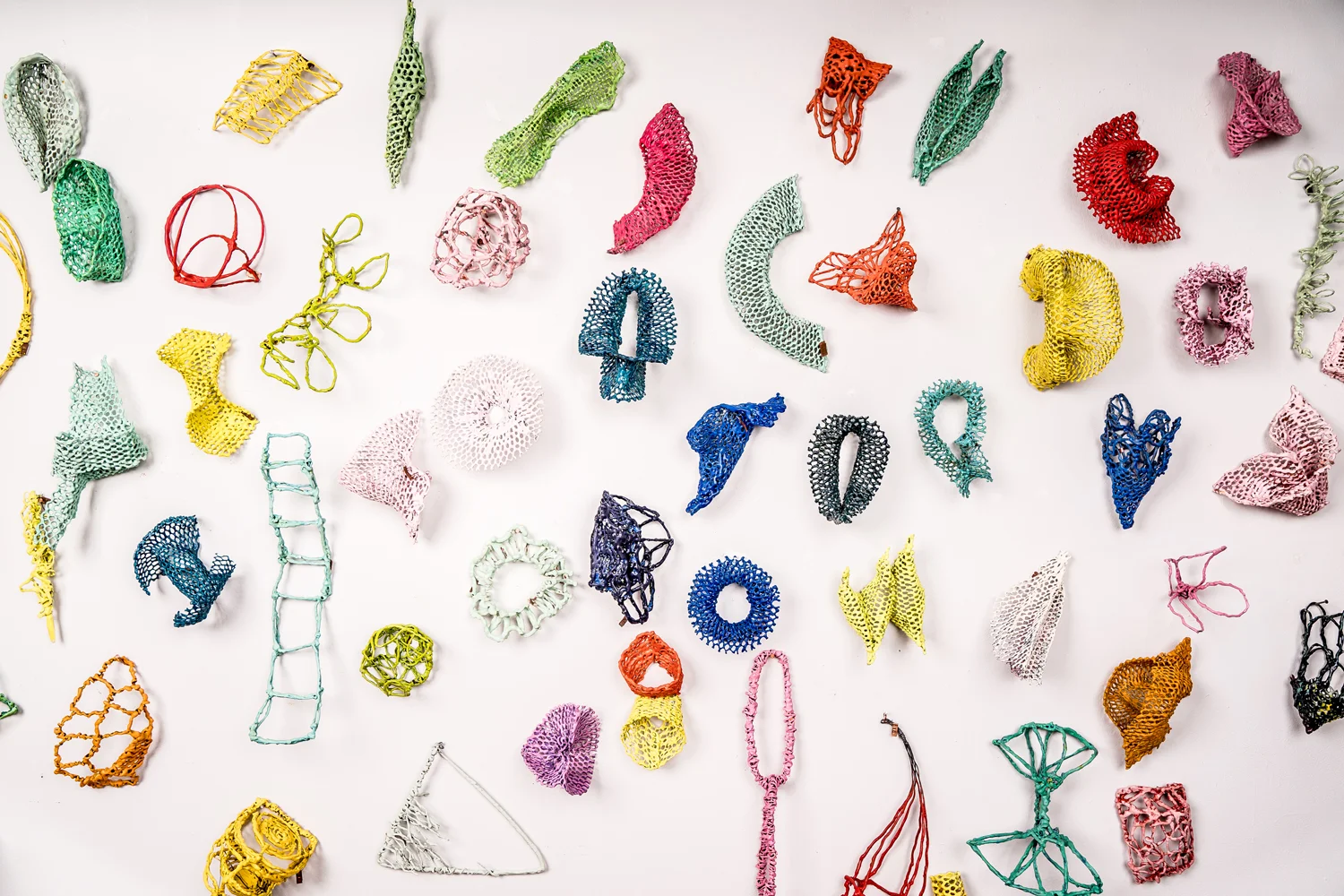
Accumulated Color: Kelly Sheppard Murray

Accumulated Color: Kelly Sheppard Murray
June 8 - July 23
ARTIST STATEMENT
Guided by the idea that consistent small actions create significant impact, these small sculptures grow the body of work over time. This process of creating over months or years is meant to also tie to the notion that our small actions affect the world beyond us. I encase, cover, stitch or layer found, industrial, cast-off or surplus materials to create objects or images that are not easily identified as natural or man-made. The pieces begin without an initial plan but instead rely on an intuitive response to the materials and a search for forms that feel familiar. Bold color and the process of building up encaustic wax to transform industrial materials has been central part of the visual outcome and process of this series. The small individual pieces have grown to a considerable collection that offers endless configurations and groupings to explore different relationships. Each piece is marked with a numbered copper tag to indicate the order in which it was created. Studying, organizing and categorizing the objects by color, form or other characteristics during the exhibitions becomes a bit of a process like a scientist’s study of plants, animals or fungi led by a curiosity to see the similarities and differences that occur over time in the process of creating.
ARTIST BIO
Kelly Sheppard Murray is a Raleigh, North Carolina artist, educator and designer with BFA, and MFA degrees from UNCG and ECU respectively. Murray’s career as an artist has emphasized three-dimensional design and fabrication for nature, health, science, and history museums, although her personal practice includes a wide array of media and processes.
While maintaining professional practice in design and fine arts, Murray teaches 2D & 3D design, painting, sculpture and art appreciation at Wake Technical Community College. In 2014, Murray was awarded faculty rank as Associate Professor at Wake Technical Community College
Murray is a 2018 recipient of the International Encaustic Artists Emerging Artist Grant. Other recognitions include being selected as a 2016 the Artspace Regional Emerging Artist in Residence, as well as a 2000 and 2012 recipient of Regional Artist Project Grant by the United Arts of Raleigh and Wake County. She now maintains a tenant studio at Artspace in order to be able to continue sharing work and having conversation with the public.
Recent exhibitions include a solo exhibition Kelly Sheppard Murray: Sculptures at Wilma Daniels Gallery, Wilmington, NC; Knoxville Tennessee’s Dogwood Arts 2018 Regional Arts Exhibition, Raleigh Fine Arts Society’s 2018 North Carolina Artists Exhibition, Artspace’s 30th Anniversary Retrospective Juried Exhibition.
Lost and Preserved: Eun-Kyung Suh

Lost and Preserved
Eun-Kyung Suh
May 3 - 31
ARTIST STATMENT
Suh will construct multiple pentagonal and hexagonal boxes that can be arranged next to one another on a wall in appropriate patterns symbolizing ethnic enclaves. Her focus is the assimilation process of immigrants of color and their formation of ethnic concentrations in the settled areas. Immigrants often cluster in close geographic areas and develop migrant networks, thus forming ethnic enclaves. The transitional phase of learning a new language and social norms of the country restricts immigrants’ activities within the enclave and subsequently sequesters them from the larger societal context. These constructed ethnic enclaves act as havens where their heritage can be preserved and fortified.
Stationary Effort - Emily Moorhead-Wallace
Stationary Effort
Emily Moorhead-Wallace
January 4 - February 1, 2019

Stationary Effort
Emily Moorhead-Wallace
January 4 - February 1, 2019
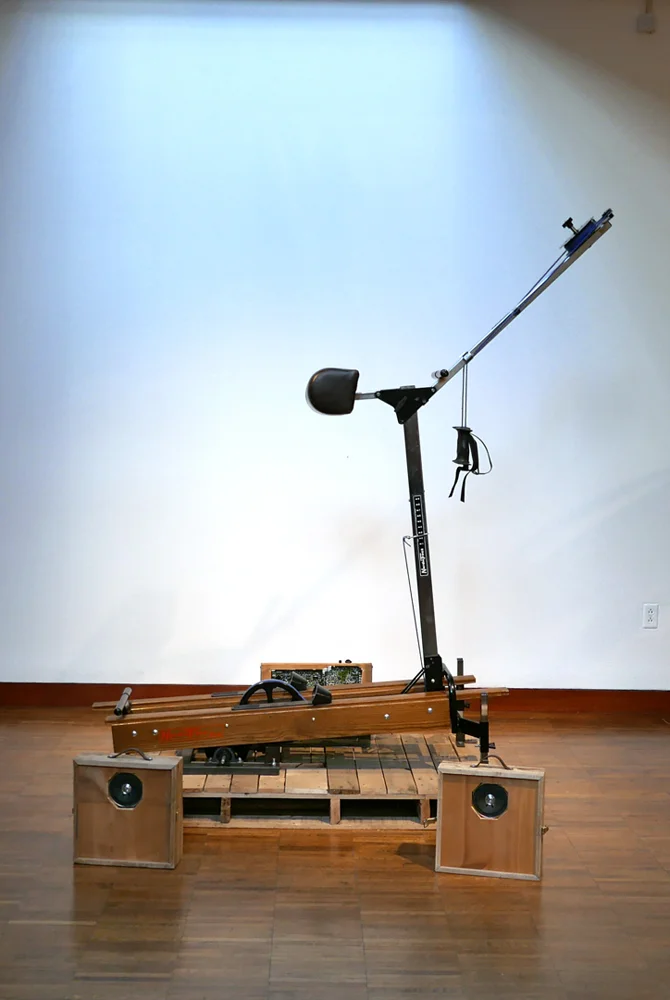
Originating from a desire for unattached musical enjoyment, Stationary Effort is a series of human driven audio players. In Stationary Effort a performer pedals a bike that turns a front flywheel, which hits an idler wheel, whose energy is transferred through bearings and gears to another idler wheel that spins a record platter.
Similarly in Stationary Effort 2 a performer drives skis backward propelling a central flywheel, which hits an idler wheel and bearing system that transfers the energy to a pulley system to spins a cassette supply reel. The riders attempt to regulate the musical rhythm. The audio record and cassette spin inconsistently causing perceptible distortions; familiar songs, tones, and pitches are altered.
This discordant absurdity veils the observable lack of human control over the machine and uselessness of human as accurate timekeeper. There is a push and pull between recognizing the futility of the performer’s efforts and the humor found in deformed sounds.
The future of this work is to perform the kinetic sculptures together. Each structure’s flaws will emphasize audio deformations in the futile “man as machine” stereo system.
Eddie Lohmeyer
Eddie Lohmeyer
Computer-Generated Imagery, 1908
November 2 - December 28

Computer-Generated Imagery, 1908
November 2 - December 28
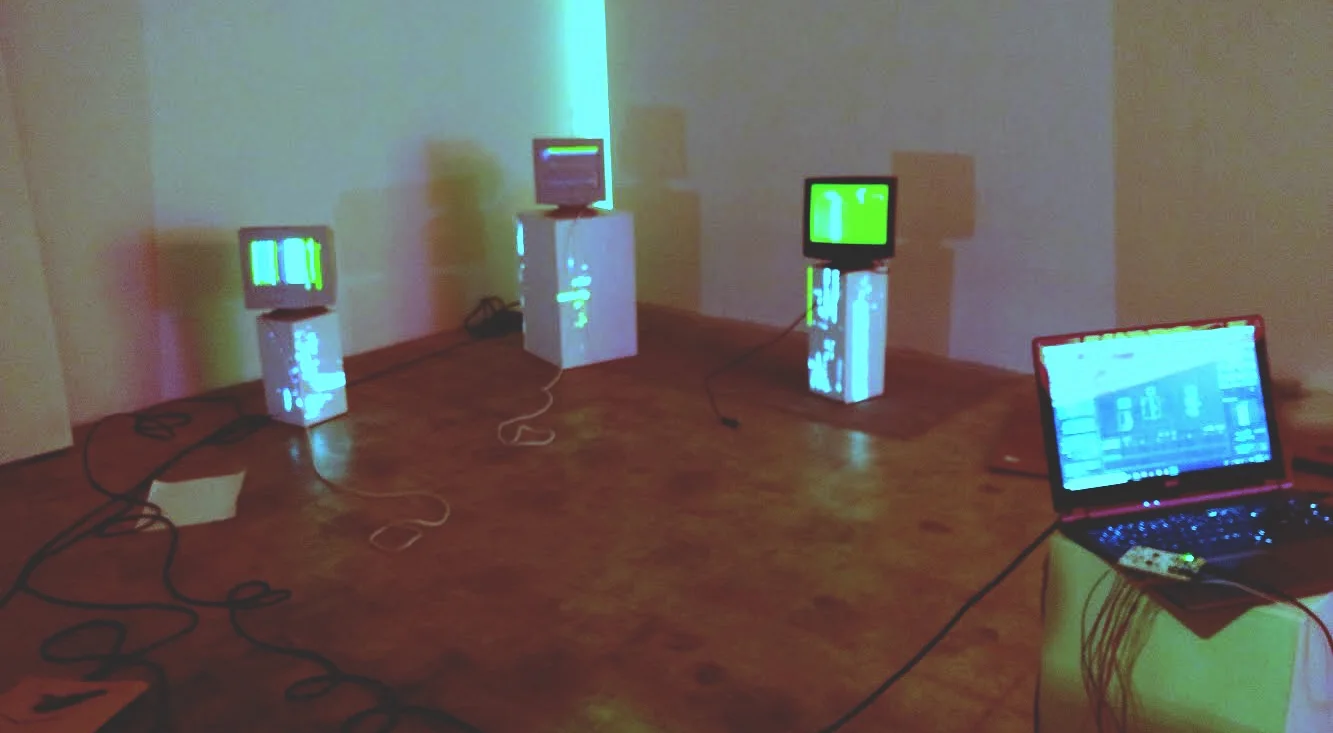
Computer-Generated Imagery, 1908 is an interactive installation that utilizes projection-mapping to animate sequences of continually-evolving glitch patterns. Each pattern is a corrupted video file of Emile Cohl’s animated film Fantasmagorie (1908). These animations are projected in layers onto the walls and screens of three “dead” computer monitors. When participants touch the circuit board pattern on the wall, they cause the projected patterns to slowly rewind, fast-forward, or reset in their respective loops, producing an on-going field of generated patterns. These animations pay homage to the absurd transformations of line and shape witnessed in Emile Cohl’s hand-drawn animated film. By evoking Cohl’s animations on the familiar interface of older CRT monitors, I consider the ways in which our experience of interactive media technologies indicates a return to earlier animation practices. That is to say, the vitality of forms within the animated image—whether in old or new modes of production—engages the senses through technical illusions and plays of movement.
PROJECT STATEMENT
My work explores the intersections between body and technological apparatus, particularly in how physical computing technologies and interactivity can open up participants to novel sensory and perceptual experiences. Through site specific sculptural and video installations, my work prompts a politics of the body that reconsiders our habitual encounters with technologies through new avenues of play and engaging with unfamiliar haptic interfaces. Here, I consider embodied experience through speculative, imaginary worlds that bring together nature and the technological, organic and machinic, biological and cybernetic. Likewise, I work to upend and play with the media interfaces we have developed a nostalgic affinity for, often through intentionally deconstructive approaches: glitch, physical modifications to hardware, and found assemblage. The bizarre and playful encounters with these strange media unveil the very nature of our normal attitudes and perceptions toward communication technologies.
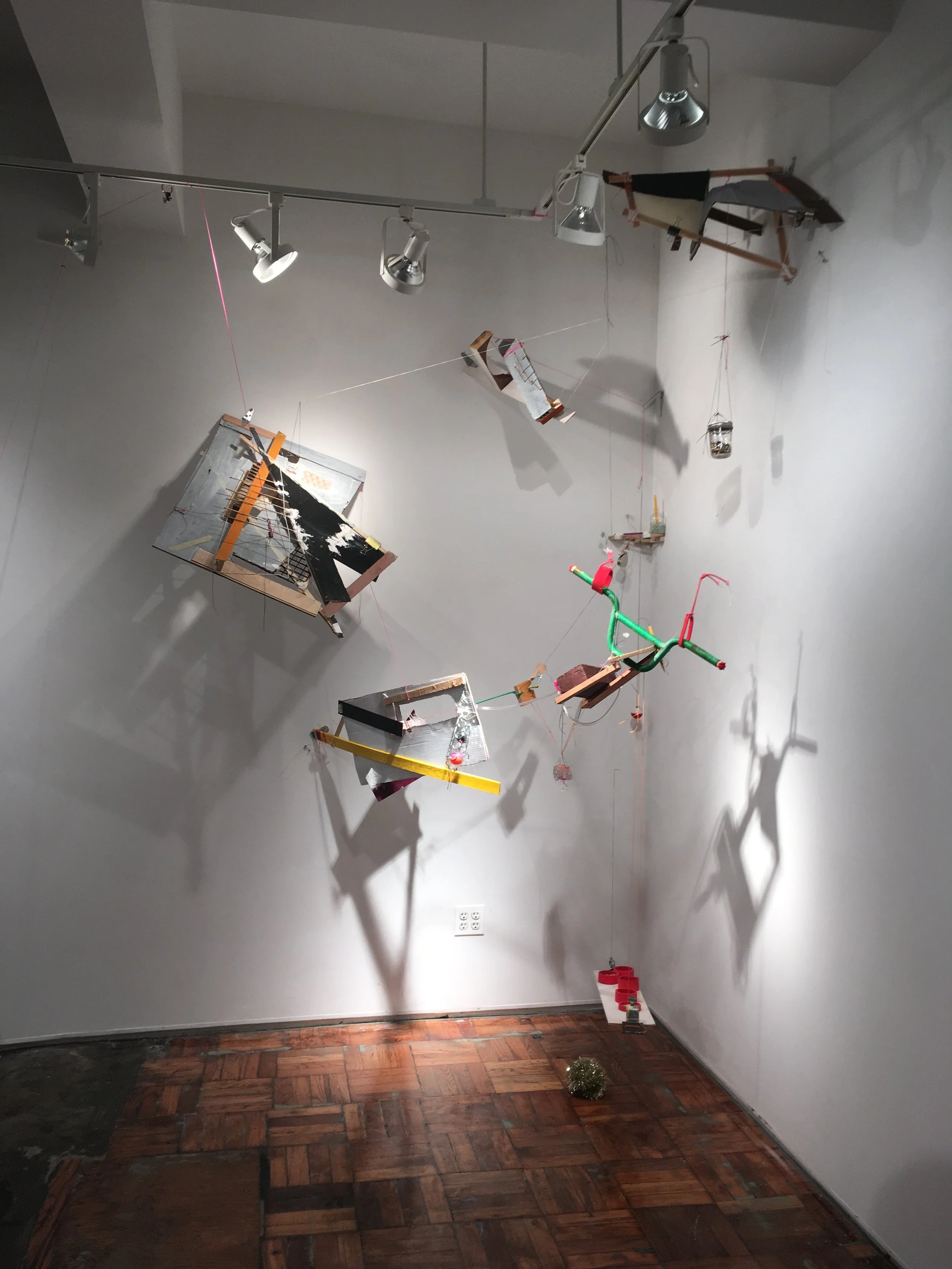
Kate Robinson - Blind Spots
Kate Robinson
September 6 - September 28
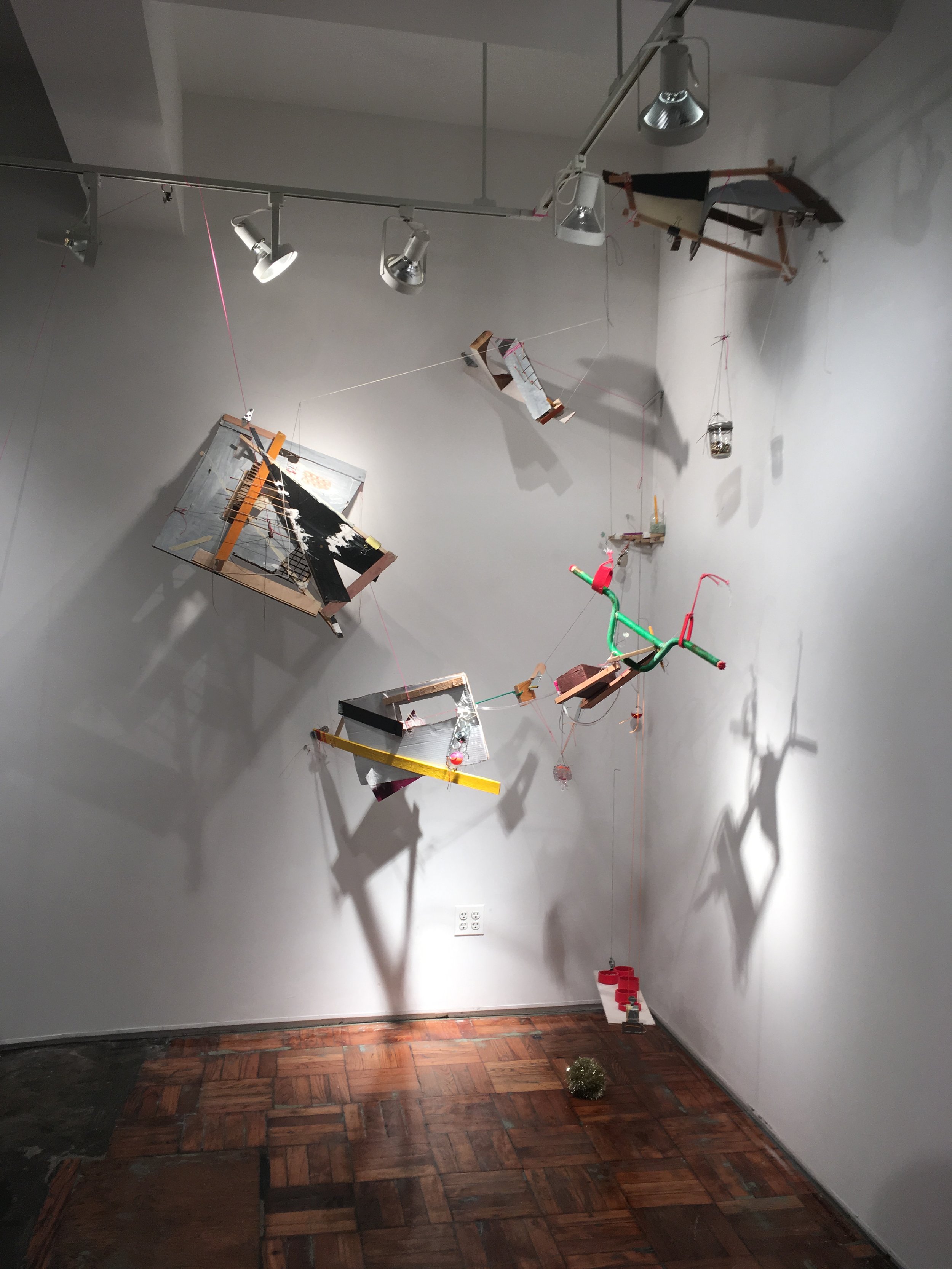
Kate Robinson
Blind Spots
September 7 - September 27
ARTIST STATEMENT
In a search to connect more deeply with her sense of place, community, environment and what it means to care for it, Kate Robinson will construct suspended structures that investigate the complex, sometimes invisible links between all things. Inspired by pop-up book mechanics and moments of odd ingenuity that happen when "factory-made" solutions break down, Robinson pieces together accumulated materials to construct spaces. In her practice, Robinson references ecosystems and the intimate relationships that form webs between parts in an effort to mimic and embody those ties. Robinson's interests lie with creating spaces that invite the viewers to interact with her work by putting in motion simple processes that reveal these convoluted relationships.
For this particular project, Robinson will construct panels from primarily collected materials and reused hardware to piece together an interactive space for the community. The idea is for visitors to be able to push, pull, spin, zip, pivot, hoist, and roll features that set in motion a small reaction unexpectedly in other parts of the exhibition. Ultimately, Robinson is asking the community to play the role of physical motion to bring the pieces to life and place yourself within it as a part of the intricate systems to which we are all bound.
ARTIST BIO
Kate Robinson is a MFA graduate of University of North Carolina at Greensboro with a background in painting, drawing and printmaking and current practice in mixed-media and site-specific installation.
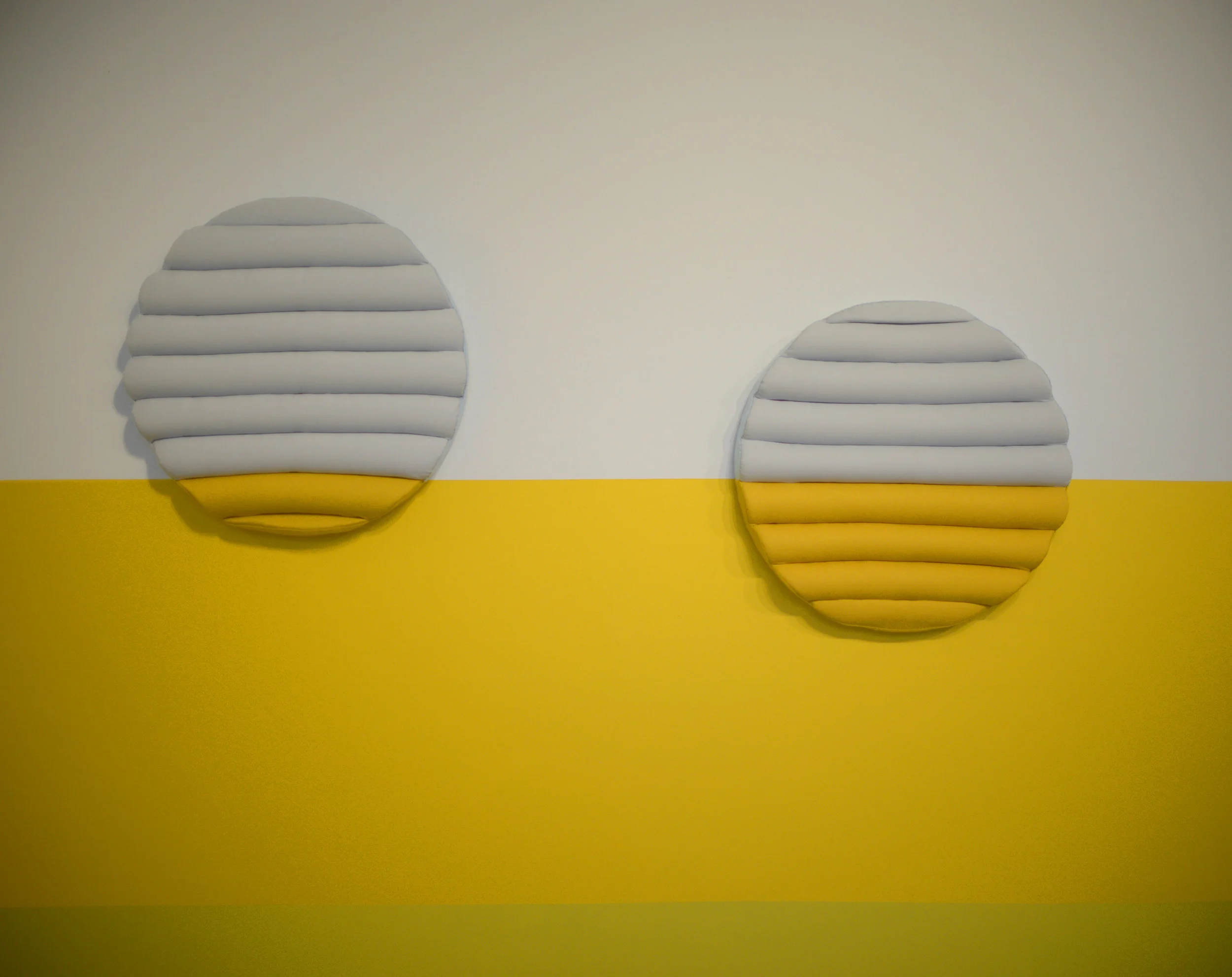
Spare Room • The Lab
Spare Room
Guilia Piera Livi
Aug. 3 - Aug. 31

Spare Room
Guilia Piera Livi
Aug. 3 - Aug. 31
I interpose objects of the everyday to distort our sense of space, explore our ability to inhabit rooms, and merge
the dreamlike with the rigid. My geometric objects and paintings focus on materiality to investigate light, shadow, and the weirdly functional. I think of paintings as they exist in the home, decorating our lives, using us to give them purpose. And inversely, objects become paintings to question abstraction and reality. My work focuses on the acute and the polite, the domestic and the utilitarian.
My current studio practice deals with the issue of interior space and design. I work to understand how we as humans find art objects to be aesthetically pleasing, how we choose to live among them in our homes. We live in a time when we rarely accept appliances that only serve one purpose, which prompts me to investigate how paintings can be multifunctional to highlight the absurdity of convenience. This question of domesticity comes from a curiosity of the curated home space, how the imperfections of home life can be contrasted with the polish of interior design. By paring abstraction with accessibility, I aim to critique these spaces, both the home and where we shop for the home, questioning the commodification of art objects and what that means for the artist. What is the role of the artist in a society with an aspiration to be modern?
If an object starts as a tiny point in space and slowly grows into the utilitarian object by which we call upon it, what does it look like just before that moment of realization? Can we still assign purpose? A subtle shift in scale, a light that’s too bright, and a water source that cannot be as clean as its linen surface. A color palette that leaves you with feelings of nostalgia and warmth, yet slight unease. Misbalance. Misbehavior.
Pick out your painting. Where will you put it?
M Y C O M E T A M O R P H I C

M Y C O M E T A M O R P H I C
Nicole Asselin
Exhibit design in collaboration with Cecilia Mouat
June 6 - July 28
Biodesign is an emerging movement that addresses designs’ connection with the natural world. Essential within the biodesign lexicon are mycelium composite materials. Mycelium is the vegetative, filamentous part of a mushroom, usually found underground. When grown within a nutrient rich substrate, the mycelium and the substrate bind together forming a stable, easily regenerated material. This growing process can be tailored to express a wide range of properties and affordances applicable for design applications. Mycelium composites are currently in use commercially as viable replacements for plastics and packing material as well as insulation, foam and leather.
This emerging design medium utilizes a transdisciplinary lens that expands the essential and timely conversation of designs’ relationship with nature and sustainability. It moves beyond the antiquated approach of simple resource conservation, developing a paradigmatic shift- inviting new ways of making that promote life-giving cycles and challenge dominate modes of production and consumption. These composite materials work with biological events as essential design components – not designing like nature, designing with natural processes. In conversation with the current concerns surrounding environmental issues, contemporary discourse in design is asking how to generate new materials and new cycles of use. Mycelium-based materials actively bring nature, science and design together to reimagining ways of producing and valuing materials.
The Protest Purse


THE PROTEST PURSE
by Kulsum Tasnif
photography by Caroline Cockrell
Exhibition: May 4 - June 16, 2018
Artist Talk: May 5th, 4-6pm
First Friday: May 4th, 6-10pm & June 1st, 6-10pm
Project Statement
For the past months I immersed myself in stories of Muslim women, learning what inspires us to resist and to exist in these times of national chaos, global catastrophes, and day to day struggles. My resistance purses are portraits of contemporary human struggles and triumphs. They are empowering, bold, and collaborative, fueled by our collective passions; they serve as a documentation of an era in which voices are silenced, yet, remaining silent is not an option. This is an ongoing project that seeks to re-contextualize how we view protest, and allows insight into the hearts and minds of a diverse community of women. And I couldn't have thought of a better partner than photographer-friend Caroline Cockrell to join me on this journey called The Protest Purse.
